
Your CFO asks you to justify next year's compliance budget. You open a spreadsheet and start listing the usual suspects: tools, audit fees, consultant hours, training. Then she asks the question you knew was coming: "What do we get for this?"
If your answer starts with "Well, we avoid fines," you've already lost the conversation. I've watched too many CISOs struggle here, and it's not because the value isn't there. It's because we've let compliance be defined by what it prevents rather than what it enables.
The business case for a real compliance program exists. You just need to build it in terms your CFO and CEO actually care about: revenue protection, competitive advantage, and enterprise value. Here's how to make that case with numbers that hold up under scrutiny.
Why "Avoiding Fines" Isn't a Business Case
The pattern I see repeatedly: security and compliance leaders lead with regulatory penalties when making their budget case. They'll cite the $5.1 million average HIPAA fine or the 4% of global revenue under GDPR. The problem is that CFOs are trained to evaluate risk as probability times impact, and they know the probability of a regulatory enforcement action is relatively low for most organizations.
More importantly, "avoiding fines" positions compliance as purely defensive spending. It's insurance. And while insurance has value, it doesn't grow the business. When your entire justification is centered on avoiding negative outcomes, you're competing for budget against every other defensive expense in the organization—and there are always more compelling risks to address.
The executives I work with who successfully secure compliance budgets frame the conversation differently. They talk about what compliance enables: contract wins they couldn't pursue otherwise, customers they'd lose without certification, insurance premiums they negotiated down with documentation in hand. This isn't marketing spin—these are quantifiable business outcomes with dollar values attached.
The Hidden Cost of Non-Compliance
Before we get to the positive case, let's reframe the defensive argument correctly. The real cost of inadequate compliance isn't the fine—it's the operational disruption that comes with an investigation or breach.
A healthcare organization I worked with faced an OCR investigation. The actual fine was $250,000. The cost of responding to the investigation—collecting documentation, executive time in interviews, remediation work, legal fees—exceeded $2 million. They spent eighteen months under a resolution agreement that required monitoring and reporting. The distraction to leadership was immeasurable.
That's the defensive case: not the penalty amount, but the full cost of regulatory scrutiny when you're not prepared. But even this argument has limits. Let's talk about what actually moves the needle in the boardroom.
Quantifying Contract Access and Revenue Protection
This is where compliance ROI gets real. In regulated industries, compliance isn't a nice-to-have—it's a prerequisite to compete for certain contracts. If you work with federal agencies, defense primes, or healthcare systems, you already know this. But have you quantified it for your finance team?
Start by identifying contracts or opportunities your organization pursues that have explicit compliance requirements. For defense contractors, that's CMMC. For healthcare technology vendors, it's HIPAA and often HITRUST. For cloud service providers selling to government, it's FedRAMP. For companies handling EU data, it's GDPR adequacy.
The math is straightforward: What's the total contract value requiring these certifications? What's your win rate? What's the expected value of the pipeline that requires compliance posture? This gives you a revenue-at-risk number.
I worked with a defense subcontractor pursuing their first prime contract. The opportunity was worth $12 million over three years. The requirement was CMMC Level 2 certification. Their compliance program cost—including gap remediation, tools, training, and assessment—was approximately $400,000 in year one and $150,000 annually thereafter. The ROI calculation was simple: spend $700,000 over three years to compete for $12 million in revenue. Even with a conservative 30% win probability, the expected value was $3.6 million against $700,000 in costs.
That's a business case a CFO understands. You're not asking for compliance budget—you're asking for the price of admission to compete for revenue. Frame it that way.
Customer Retention Through Compliance
The flip side of contract access is customer retention. Large enterprise customers increasingly require vendor compliance attestations. If you can't provide them, you're not just losing new business—you're at risk of losing existing accounts during renewal.
Look at your customer base. How many require security questionnaires? How many ask for SOC 2 reports, ISO certifications, or compliance attestations? What's the aggregate revenue from customers who've asked for these materials in the past two years?
That number represents revenue dependent on your ability to demonstrate compliance. For many B2B technology companies, this is 40-60% of total revenue. Suddenly your compliance program isn't a cost center—it's a retention program protecting half your revenue base. As you work through what a regulatory compliance program actually looks like, keep these customer requirements front and center.
Building the Business Case for Compliance at Your Organization
Carl works with executive teams to quantify compliance ROI and build programs that deliver measurable business value. His keynotes help leadership understand how to position security and compliance as business enablers, not cost centers.
Book Carl to Speak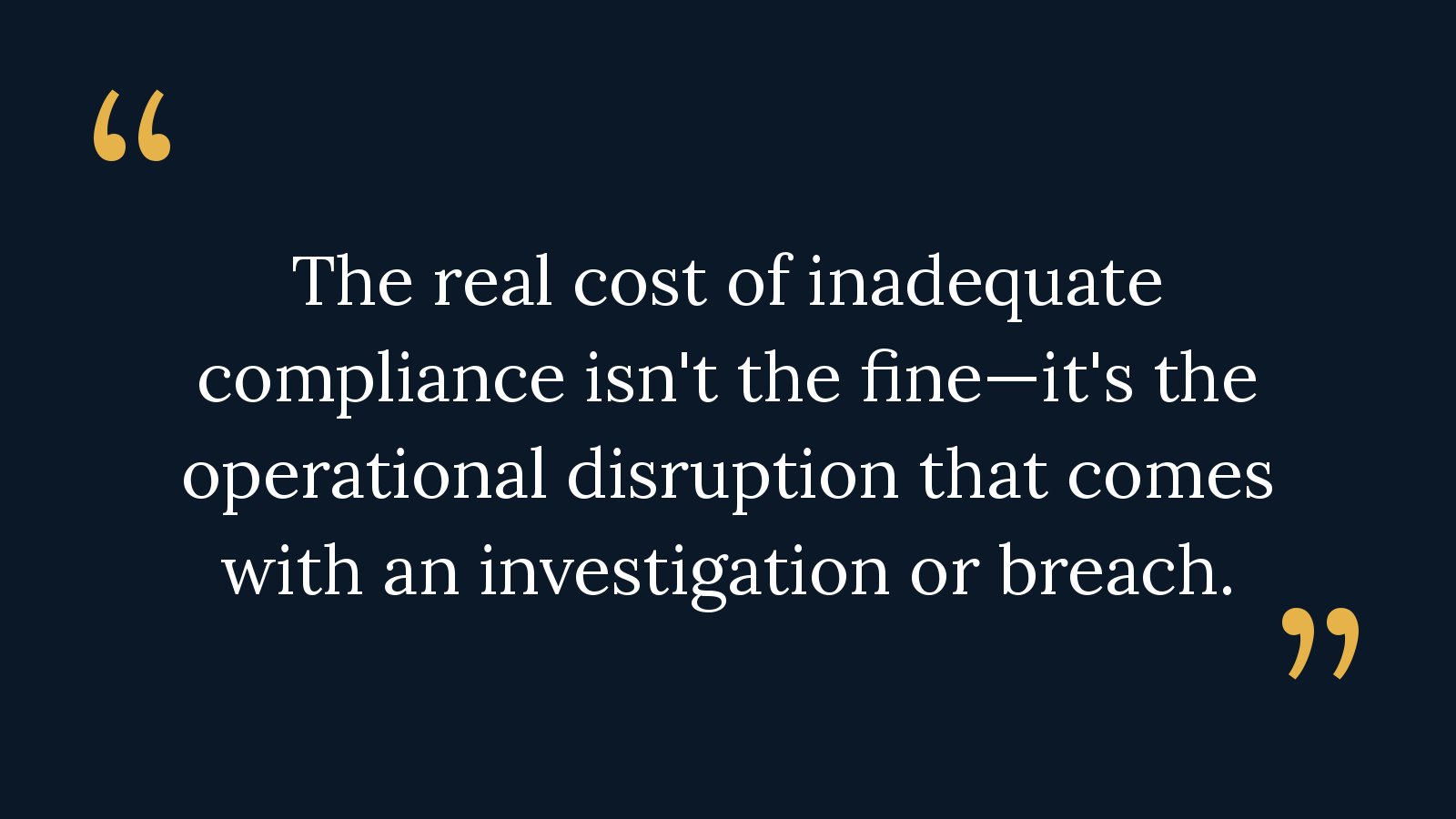
Cyber Insurance: The Most Immediate ROI
Cyber insurance premiums have increased dramatically over the past few years, and underwriters have gotten significantly more rigorous about security controls. This creates one of the most immediate and quantifiable returns on compliance investment.
I've seen organizations reduce their cyber insurance premiums by 15-30% by demonstrating mature compliance programs. The mechanism is simple: underwriters assess risk based on your control environment. When you have documented policies, regular risk assessments, incident response procedures, vendor management, and employee training—all components of a real compliance program—you present lower risk. Lower risk means better rates.
Here's how to quantify this for your business case. Get your current cyber insurance premium. Ask your broker—or better yet, ask multiple brokers—what premium reduction would be available if you achieved specific certifications or implemented specific controls. SOC 2 Type II, ISO 27001, HITRUST, and CMMC all carry weight with underwriters.
For a mid-sized company paying $200,000 annually in cyber insurance premiums, a 20% reduction is $40,000 per year. Over three years, that's $120,000 in savings. For larger organizations with premiums in the seven figures, the savings can fund a significant portion of the compliance program itself.
The pattern I see: organizations that treat insurance as a separate conversation from compliance miss this opportunity. When you coordinate your compliance roadmap with your insurance renewal cycle, you can demonstrate improved posture to underwriters at exactly the right time to capture premium reductions. This isn't theoretical—it's how risk management actually works.
Claims Coverage and Deductibles
Beyond premiums, policy terms matter. Insurers increasingly include compliance requirements in coverage terms. If you suffer a breach and didn't meet certain control baselines, your claim may be denied or reduced. Conversely, organizations with strong compliance programs negotiate better coverage terms: higher limits, lower deductibles, broader coverage.
When you're building your compliance ROI case, include both sides: the premium savings and the improved coverage terms. Your risk management team already understands this calculus—bring them into the conversation.
M&A Valuation and Due Diligence
If your organization has any possibility of being acquired—or of acquiring others—compliance program maturity directly impacts valuation. I've participated in enough due diligence processes to tell you that compliance gaps kill deals or significantly reduce purchase price.
During M&A due diligence, buyers assess regulatory risk as part of their valuation model. Material compliance gaps trigger one of three outcomes: deal termination, purchase price reduction, or escrow holdbacks. All three are expensive.
In a $50 million acquisition, a 5% purchase price reduction due to compliance gaps costs the selling organization $2.5 million. That's not a hypothetical percentage—I've seen reductions of 3-8% based on security and compliance findings. The most common triggers: lack of vendor risk management, insufficient incident response capabilities, gaps in data protection controls, and missing compliance documentation.
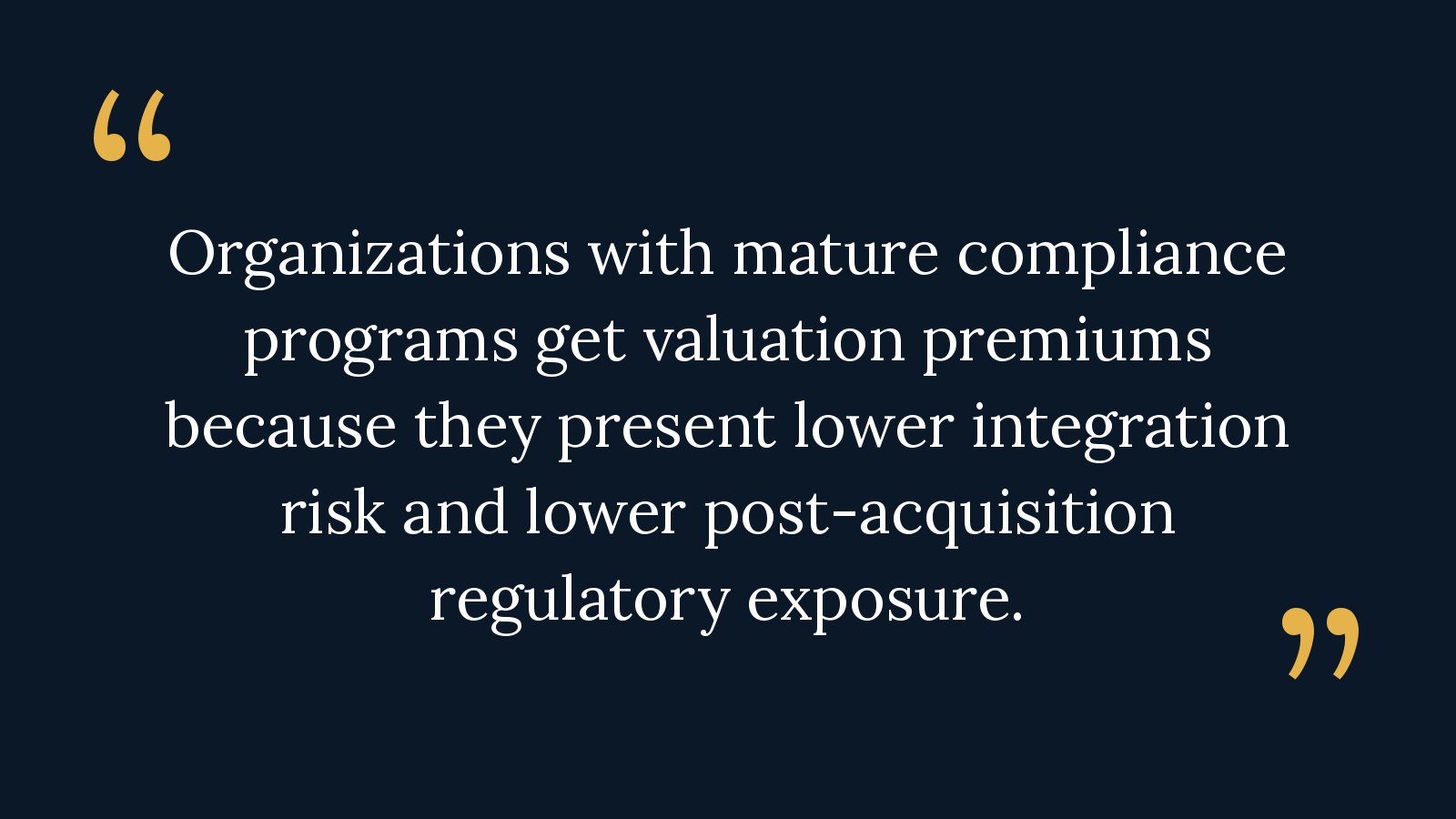
The inverse is also true. Organizations with mature, well-documented compliance programs get valuation premiums. They present lower integration risk and lower post-acquisition regulatory exposure. For private equity buyers especially, who plan to roll up multiple acquisitions, buying a compliant platform is worth paying for.
Time to Close
Beyond valuation, compliance readiness affects deal timeline. Due diligence that uncovers significant gaps extends the process, sometimes by months. Extended timelines increase costs and create deal risk—market conditions change, financing terms shift, buyers get cold feet.
Organizations with compliance programs ready for due diligence close faster. They have documentation organized, policies current, risk assessments complete, and vendor contracts reviewed. This operational readiness has real value, even if it's harder to quantify than a direct valuation premium.
Customer Trust and Competitive Differentiation
This is where the business case gets softer, but no less real. In competitive sales situations, security and compliance posture increasingly serve as differentiators. When two vendors offer similar functionality at similar price points, the one with better security documentation wins.
The challenge is quantifying this for your CFO. You can't easily isolate compliance as the deciding factor in a deal win. But you can track patterns. Look at your win/loss data. For opportunities where security came up during evaluation, what was your win rate? For deals where you provided compliance documentation early in the sales cycle versus scrambling to respond to security questionnaires, how did close rates differ?
Sales teams know this intuitively—they'll tell you that customers care about security. But to build a business case, you need data. Pull reports on opportunities where compliance requirements were explicit evaluation criteria. Calculate win rates and average deal sizes. Even directional data helps: "We won 60% of opportunities where we led with compliance documentation versus 35% where we responded reactively to security questionnaires."
Brand Protection and Customer Confidence
Breaches and compliance failures damage brands. The business impact—customer churn, revenue loss, reputation damage—typically exceeds the direct costs of the incident by an order of magnitude. For public companies, stock price impact can be severe and sustained.
This is harder to quantify prospectively, but you can point to industry examples. Healthcare breaches lead to patient attrition. Financial services breaches trigger account closures. The costs are real, well-documented, and entirely preventable with proper compliance programs. Understanding what regulatory compliance actually means helps frame these risks appropriately for executive audiences.
Need Help Making the Compliance Business Case?
Carl delivers keynotes on compliance ROI, GRC strategy, and building programs that deliver business value. He helps leadership teams understand how to position and fund compliance initiatives that protect and grow the business. See all keynote speaking topics or reach out about your event.
Book Carl for Your EventOperational Efficiency Gains
Mature compliance programs create operational efficiencies that reduce costs over time. This is counterintuitive to executives who see compliance as purely overhead, but the pattern is clear: organizations that build real programs spend less time on compliance activities than organizations that operate reactively.
Consider audit preparation. Organizations without compliance programs spend weeks scrambling before audits—pulling documentation, interviewing staff, remediating findings. Teams that maintain continuous compliance posture spend a fraction of that time. Instead of three people working full-time for six weeks preparing for an audit (approximately 720 hours), a mature program requires perhaps 40 hours of preparation.
At a loaded cost of $100 per hour, that's $72,000 in preparation costs reduced to $4,000. If you undergo multiple audits annually—SOC 2, ISO, customer audits, regulatory examinations—the time savings compound quickly.
The same efficiency gains apply to security questionnaires and RFP responses. Organizations with mature compliance programs maintain libraries of pre-approved responses, documentation packages, and attestations. Sales teams can respond to security requirements in hours instead of weeks. This accelerates sales cycles and reduces the burden on security and legal teams.
Reduced Remediation Costs
Reactive compliance is expensive. When you discover gaps during an audit or incident, remediation happens under time pressure, often with consultants billing premium rates. Proactive compliance—building controls before they're required—costs significantly less.
I worked with a healthcare organization that waited until an OCR investigation to implement a comprehensive risk management program. They spent $800,000 on emergency consulting, technology deployment, and remediation over nine months. A comparable organization that built the same program proactively spent $350,000 over two years. The reactive approach cost more than twice as much and caused significant business disruption.
When you're building your ROI case, quantify reactive versus proactive costs. Get quotes for building a program on your timeline versus emergency remediation. The delta is your cost avoidance number.
Building the CFO-Ready Business Case
Now that you have the components, here's how to assemble them into a business case that holds up in the budget process. Your CFO thinks in terms of cash flows, risk-adjusted returns, and payback periods. Present your case in those terms.
Start with a simple financial model. In Excel or Google Sheets, create a three-year projection with the following structure:
Costs: Initial investment (gap remediation, tools, training), annual operating costs (licenses, assessments, staff time), one-time expenses (certifications, consulting).
Benefits: Revenue enabled (contract values requiring compliance), revenue protected (retention risk from customers requiring attestations), cost savings (insurance premiums, operational efficiency, reduced audit preparation), risk reduction (quantified as avoided costs—breach response, regulatory investigation, M&A valuation impact).
For each benefit category, use conservative assumptions. If insurance brokers suggest 15-30% premium reductions, use 15%. If you could win a $12 million contract but your probability is uncertain, use 25%. Financial teams respect conservative assumptions because they know you're not inflating the case.
Calculate net present value and payback period. For most mature compliance programs, payback occurs in 12-24 months when you include contract access and insurance savings. Over three years, the ROI is typically 200-400% for organizations in regulated industries. Those are numbers that compete favorably with other capital investments.
The Conversation with Your CFO
When you present this case, lead with revenue and competitive positioning. "This program enables us to compete for $X in contract value and protects $Y in existing customer revenue." Quantify those numbers specifically for your organization.
Then layer in the cost savings: insurance premiums, operational efficiency, audit preparation. These are concrete, near-term benefits that show up in departmental budgets.
Finally, address the risk reduction: M&A impact, breach costs, regulatory investigation. Frame these as tail risk protection—unlikely but catastrophically expensive if they occur. Your CFO understands this language because it's how they think about all enterprise risks.
Be prepared for questions about assumptions. If you claim compliance will enable contract wins, be ready to name specific opportunities in your pipeline with explicit compliance requirements. If you cite insurance savings, bring the broker conversation or written quotes. Specificity builds credibility. For more context on how these programs operate in practice, review what goes into building a regulatory compliance program that can deliver these outcomes.
Common Objections and How to Address Them
You'll face pushback. Here's what I hear most often and how to respond:
"We haven't had problems so far without this investment." Survivorship bias. The fact that you haven't faced regulatory action or lost a major customer doesn't mean the risk is zero—it means you've been lucky. More importantly, the competitive landscape has changed. Requirements that were optional three years ago are table stakes today. Point to specific RFPs or customer requests you've received recently.
"Can't we just do the minimum to pass audits?" Sure, but minimum compliance programs cost almost as much as good ones and deliver none of the strategic benefits. You'll spend money on assessments and tools regardless. The incremental cost to build a program that enables contracts and reduces insurance premiums is modest. The difference in outcome is substantial.
"This seems like IT's job, not a business investment." This is a positioning problem. If compliance is perceived as IT overhead, you've lost. Reframe it as a business capability that happens to be delivered through technology and process. The goal isn't security for its own sake—it's protecting and enabling revenue.
"What if regulations change?" They will. That's precisely why you need a program, not point solutions. Organizations with mature compliance programs adapt to new requirements efficiently because they have the governance structure, documentation practices, and risk management processes already in place. Reactive organizations rebuild from scratch each time regulations shift.
What This Means for CISOs and Security Leaders
The business case for compliance ROI exists, but you have to build it in business terms. This means thinking like a CFO, not like a security practitioner. It means quantifying outcomes that executives care about: revenue, costs, competitive position, enterprise value.
The most successful security leaders I know don't talk about compliance as a technical program. They talk about it as business enablement. They sit in pipeline reviews and identify which opportunities require compliance posture. They sit in customer renewals and track which accounts require security attestations. They sit in budget planning and quantify insurance savings and operational efficiency gains.
This is fundamentally about positioning. Compliance programs that get funded are positioned as investments that grow and protect the business. Programs that struggle for budget are positioned as defensive costs that prevent bad things from happening. The actual work might be identical, but the framing determines whether you get the resources to do it right.
If you're preparing your compliance budget for next year, start building this case now. Pull the contract data, talk to your insurance broker, quantify the operational costs of reactive compliance. Build the three-year financial model. When budget season arrives, you'll have a business case that competes favorably with every other investment the organization is considering.
That's how you win the compliance ROI conversation. Not by avoiding fines, but by enabling growth.