
I walked into a CEO's office last month to discuss our security roadmap. Five minutes in, he asked me point-blank: "Are we secure?" I've heard this question dozens of times across healthcare organizations, defense contractors, and federal suppliers. It's the wrong question, but it reveals exactly what's broken in most CISO-CEO relationships.
The CEO wasn't asking for a binary answer. He was asking whether he could sleep at night, whether we'd end up in the headlines, whether our customers would trust us with their data. But because I'd positioned myself as the person who managed firewalls and patched servers, that's the conversation we were having. I was the IT person who handled cyber stuff, not a business leader who translated risk into language he could act on.
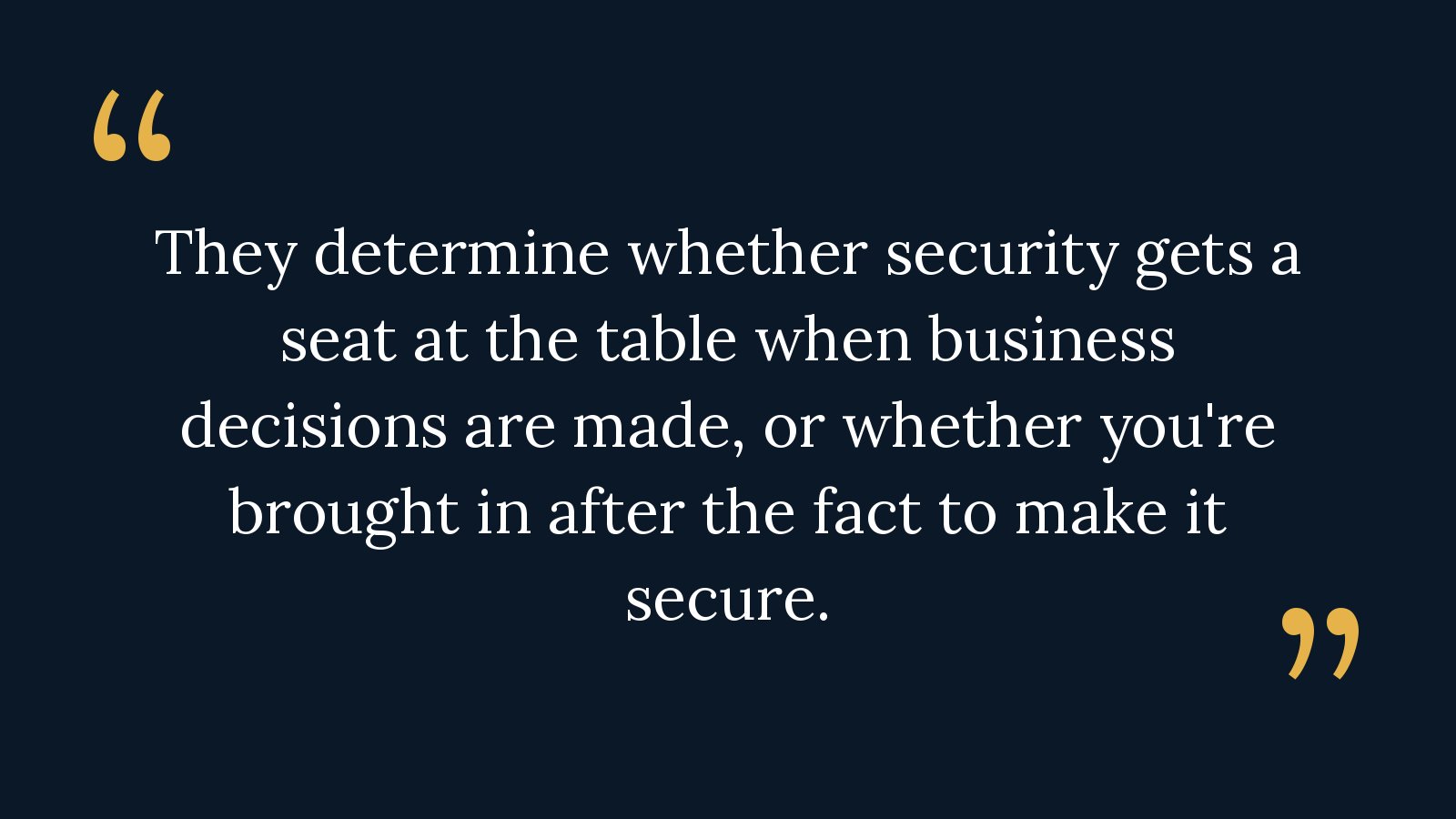
That meeting changed how I approach CISO CEO alignment. The questions you ask your CEO matter more than the answers you give to theirs. They establish whether you're a strategic partner or a technical resource. They determine whether security gets a seat at the table when business decisions are made, or whether you're brought in after the fact to "make it secure."
Why Most CISOs Ask the Wrong Questions
The pattern I see in struggling CISO-CEO relationships: the security leader asks for budget, headcount, and executive support. These aren't bad questions, but they frame the CISO as a supplicant requesting resources, not a leader managing enterprise risk.
When you ask "Can I have three more analysts?" you're asking the CEO to solve your staffing problem. When you ask "What's our tolerance for a two-hour revenue disruption during peak season?" you're helping the CEO understand business risk. The first question positions you as a cost center. The second positions you as someone who understands what keeps revenue flowing.
I learned this the hard way in the defense industrial base. We needed to implement multi-factor authentication across our engineering systems to meet CMMC requirements. I initially approached the CEO asking for the MFA solution budget. He pushed back on cost. Fair enough—I'd framed it as a compliance expense.
Two weeks later, I came back with a different question: "If we lose our DoD contracts because we can't prove we're protecting CUI, what's our revenue exposure?" That conversation lasted ten minutes. We had budget approval and an implementation timeline by the end of the week. Same project, different framing.
What's Your Definition of an Acceptable Breach?
This is the first real question every CISO should ask their CEO, and it's the one that makes executives most uncomfortable. Good. Discomfort means you're having the right conversation.
Most organizations operate with an implicit risk tolerance they've never articulated. The CEO has some vague notion that "we should be secure" but hasn't defined what level of loss, disruption, or exposure is acceptable. You need that definition before you can build an effective security program.
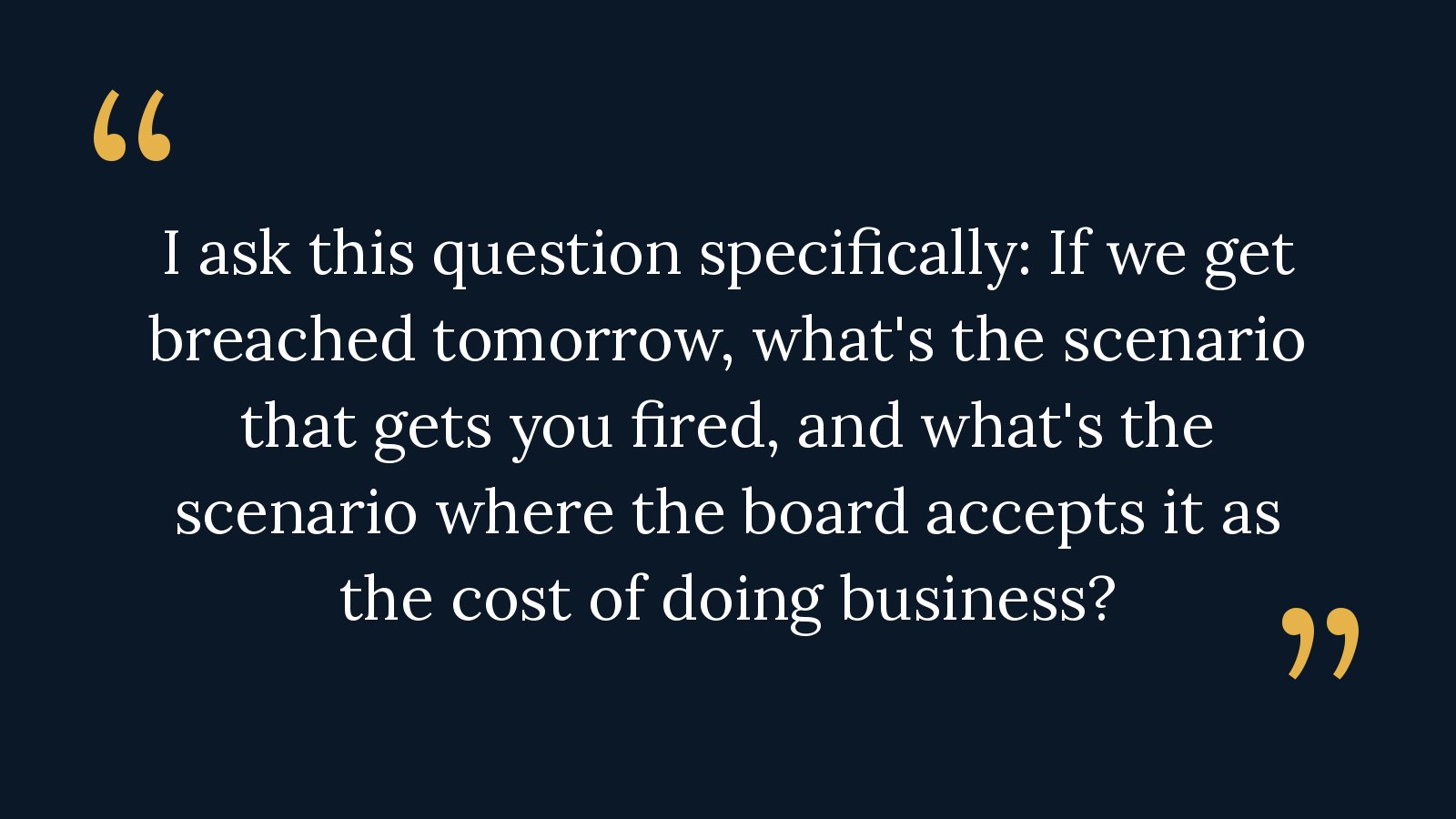
I ask this question specifically: "If we get breached tomorrow, what's the scenario that gets you fired, and what's the scenario where the board accepts it as the cost of doing business?" That's not hypothetical. That's strategic planning.
In healthcare, I've seen this play out clearly. A breach affecting 500 patient records because an employee fell for a sophisticated phishing attack? Unfortunate but defensible. A breach affecting 50,000 records because we didn't patch a known vulnerability for six months? Career-ending. The CEO needs to articulate that distinction so you can allocate resources accordingly.
Translating Acceptable Risk into Resource Allocation
Once you understand what constitutes an acceptable versus unacceptable breach, you can map your security investments to business priorities. This is where CISO CEO alignment becomes operational, not just philosophical.
At a federal contractor, our CEO defined our crown jewels clearly: engineering designs, customer data, and our proprietary software. Losing those would be catastrophic. Losing HR records or marketing materials? Bad, but survivable. That clarity let me build a tiered security model that concentrated resources where business impact was highest.
The alternative—treating all data as equally sensitive—burns budget on low-value targets while underfunding critical assets. I see this constantly in organizations where the CISO hasn't had the "acceptable breach" conversation. They're spending the same money, just spreading it evenly across assets with wildly different business value.
How Do You Make Strategic Decisions When You Don't Have Complete Information?
Security operates in permanent uncertainty. You'll never have complete threat intelligence, perfect visibility, or total assurance. If the CEO needs certainty before making security investments, you're going to struggle.
I ask CEOs this question to understand their decision-making framework. Some executives are comfortable with probabilistic thinking: "We believe there's a 60% chance this control reduces our ransomware risk by half, so we're moving forward." Others need more certainty, which means I need to invest more in measurement and evidence before proposing initiatives.
This matters for how you present security recommendations. A CEO who's comfortable with uncertainty wants to hear: "Based on what we're seeing in our industry and our current control gaps, I recommend we invest here." A CEO who needs more certainty wants: "I've run tabletop exercises with operations, talked to three peer organizations, and modeled our exposure. Here's what the data shows."
Neither approach is wrong, but mismatching your presentation style to your CEO's decision-making framework kills security initiatives. I've watched CISOs present solid recommendations that died because they came in with high confidence when the CEO wanted probabilistic thinking, or with ranges and likelihood when the CEO wanted a clear recommendation.
Strengthen Your Executive Security Communications
Carl speaks regularly on translating technical security into business risk language, helping security leaders build stronger relationships with executive teams and boards. His sessions provide practical frameworks that work in regulated environments.
Book Carl to SpeakWhat Business Initiative Keeps You Up at Night from a Risk Perspective?
This is my favorite question because it flips the script. Instead of the CISO talking about security risks, you're asking the CEO to identify business risks. Their answer tells you where security should focus.
In my experience, CEOs rarely say "ransomware" or "data breaches" when you ask this question. They say things like: "We're expanding into three new states and I'm worried about regulatory compliance," or "We're launching a patient portal and if it goes down during flu season we're screwed," or "We're bidding on a contract that requires FedRAMP and I don't know if we can get there."
These are security problems, but they're framed as business problems. That's the language you need to operate in. When the CEO tells you they're worried about state expansion, you're not talking about HIPAA compliance frameworks—you're talking about speed to market and competitive positioning. Security becomes the enabler that lets them expand confidently, not the barrier that slows them down.
At a healthcare organization, the CEO's answer to this question was revealing: "We're implementing telehealth and I'm worried patients won't trust it." Not a technical concern about video encryption or access controls. A business concern about patient confidence and adoption rates. That reframed our entire telehealth security strategy. We focused on visible trust signals—transparent privacy practices, clear data handling explanations, prominent security certifications—because those drove patient adoption.
Aligning Security Roadmap to Business Priorities
The CEO's risk concerns should directly shape your security roadmap. I've seen too many CISOs build security programs based on framework requirements or industry best practices while ignoring what their CEO actually cares about.
If your CEO is worried about regulatory expansion, your roadmap should prioritize scalable compliance capabilities. If they're worried about system availability during peak business periods, your roadmap should prioritize resilience and incident response. If they're worried about losing a key contract due to security requirements, that contract's security profile becomes your north star.
This doesn't mean you ignore foundational security. It means you sequence and frame initiatives based on business priorities. The CEO who's worried about regulatory expansion will fund a compliance automation platform. That same CEO might balk at funding the identical platform if you position it as "improving our security posture." Same tool, different framing, different outcome.
Who Owns Security Risk in This Organization?
This question exposes whether you have actual support or just verbal support. If the CEO's answer is "You do, you're the CISO," you've got a problem. Security risk is business risk. The CISO manages security controls, but business leaders own the risk those controls are designed to address.
I've operated under both models. In organizations where business leaders own risk, they show up to threat briefings, they participate in tabletop exercises, they make hard decisions about risk acceptance. In organizations where "the CISO owns security," you get executive teams that treat security as your problem until there's a breach, then suddenly it's everyone's problem and you're explaining why you didn't prevent it.
The pattern I see in effective CISO CEO alignment: the CEO clearly articulates that department heads own risk in their domains. The VP of Engineering owns risk in the development pipeline. The VP of Operations owns risk in operational technology. The CISO provides the expertise, tools, and guidance to help them manage that risk effectively.
This is particularly critical in regulated industries. In healthcare, understanding what regulatory compliance actually means isn't just the CISO's job—it's every department head's responsibility. When a HIPAA violation occurs in the billing department, the CFO should be in the room explaining what went wrong and how they're fixing it, not the CISO explaining why the CFO's team didn't follow security policies.
Building Distributed Security Ownership
Once the CEO agrees that business leaders own risk, you need to operationalize that ownership. I use a simple framework: every major business system or process has an identified risk owner who's accountable for making risk decisions.
At a defense contractor, we mapped every CUI-handling system to an executive owner. The VP of Engineering owned risk for the CAD systems. The VP of Contracts owned risk for the proposal management system. When we needed to make tradeoff decisions—speed versus security, functionality versus control—those executives made the call with my input.
This isn't abdication. The CISO still sets standards, provides expertise, and operates security controls. But you're not making business risk decisions in a vacuum. You're giving business leaders the information they need to make informed tradeoffs, then implementing controls based on their risk acceptance.
What Would Cause You to Pull Me Into a Business Decision Early?
Most CISOs spend too much time trying to get invited to meetings. This question tells you explicitly what would earn you a seat at the table. The CEO's answer reveals what they actually value from security leadership.
Some CEOs bring security in early for anything customer-facing. Others bring security in early for M&A activity. Others bring security in early for new market expansion or regulatory changes. Whatever the CEO's answer, that's your lane for strategic involvement. Everything else might be important, but it won't get you in the room when business strategy is being formed.
I had a CEO tell me honestly: "I'll bring you in early when we're evaluating acquisition targets or entering new markets where I don't understand the regulatory landscape." Clear answer. That meant I needed to become literate in M&A due diligence and regulatory requirements across our expansion targets. I shifted my professional development accordingly.
That CEO didn't bring me into product development decisions early. That was fine—I wasn't going to force my way into those meetings. But when an acquisition target emerged or we looked at expanding into California with its consumer privacy requirements, I was in the room from day one. I'd earned that seat by being valuable in the specific contexts the CEO cared about.
Help Your Leadership Team Think Strategically About Security
Carl delivers keynotes and workshops on executive security leadership, board-level cyber risk communication, and building effective security governance in regulated environments. See all keynote speaking topics or reach out about your event.
Book Carl for Your EventHow Do You Want to Hear About Security Failures?
You're going to have security incidents. Controls will fail. Employees will click malicious links. Vendors will get breached. The question is whether your CEO hears about it from you or from someone else.
I ask CEOs specifically how they want bad news delivered. Some want immediate notification of anything significant, even if you don't have full details. Others want you to gather facts first, then brief them on confirmed information. Some want a quick Slack message followed by a detailed brief. Others want everything in writing.
Getting this wrong destroys trust. I watched a CISO get fired after a significant phishing incident. The technical response was solid—they contained it quickly, minimal data exposure, good recovery. But they waited 48 hours to brief the CEO because they wanted complete information first. The CEO found out from a worried board member who'd heard from another employee. The CISO's technical competence didn't matter. They'd violated the CEO's communication expectations.
This ties directly to how you think about protecting privacy and sensitive information. The CEO needs to know your notification protocols aren't just about external compliance—they're about internal trust.
Establishing Clear Escalation Thresholds
Beyond delivery preferences, you need clear thresholds for what gets escalated and when. I work with CEOs to define specific triggers: any suspected data breach, any compliance violation with potential regulatory reporting, any system outage affecting revenue operations, any security incident requiring customer notification.
These thresholds should be documented and agreed upon. When an incident occurs, you're not making a judgment call about whether the CEO wants to know—you're following the protocol you established together. That removes ambiguity and reduces the chance you'll misjudge what's escalation-worthy.
At a healthcare organization, we set a clear threshold: any potential PHI exposure affecting more than 50 patients got immediate CEO notification, regardless of time of day. Below that threshold, I had discretion to handle it and brief during business hours. That clarity meant I never hesitated during an incident. I knew exactly when to pick up the phone.
What Security Investment Would You Fight For If Budget Gets Cut?
This question tells you what the CEO actually values versus what they say they value. When money gets tight, priorities become real. Understanding what security capabilities your CEO considers non-negotiable helps you build a defensible security program.
I've had CEOs give surprising answers to this question. One told me bluntly: "I'd fight for incident response capabilities and anything directly tied to contracts. Everything else is negotiable." That was clarifying. It meant I needed iron-clad incident response, robust contract security requirements, and flexibility everywhere else. When budget cuts came six months later, we were prepared.
Another CEO told me: "I'd fight for anything preventing ransomware and anything required for our SOC 2 audit." Different organization, different priorities. That CEO had watched a competitor get destroyed by ransomware and knew our enterprise customers required SOC 2. Everything else—compliance frameworks, advanced threat detection, security awareness programs—was secondary.
These aren't comfortable conversations, but they're necessary. You can't defend your entire security budget equally. You need to know which hills the CEO will die on and which they'll concede. That lets you architect a security program that's resilient to budget pressure because you've concentrated resources on what the business truly values.
Building a Defensible Security Budget
Once you understand the CEO's priorities, you can structure your budget to survive scrutiny. I separate security investments into three tiers: foundational capabilities the CEO has committed to defending, risk-reduction initiatives tied to identified business priorities, and optimization investments that improve efficiency or coverage.
When budget pressure comes—and it will—tier three gets cut first, tier two gets evaluated based on changing business priorities, and tier one is defended aggressively. This isn't just budget management. It's ensuring that CISO CEO alignment remains intact during financial stress.
At a federal contractor, we faced 15% budget cuts across all departments. I'd had the "what would you fight for" conversation with the CEO six months earlier. His answer: anything required for CMMC compliance and anything protecting our engineering systems. When cuts came, I proposed eliminating our security awareness platform upgrade, deferring our SIEM expansion, and reducing our penetration testing frequency. I protected CMMC-related controls and engineering security completely. The CEO approved the cuts immediately because they aligned with his stated priorities.
The CISO as Business Leader, Not IT Function
The questions you ask your CEO determine whether you're operating as a strategic business leader or a technical specialist. Technical specialists get asked "Are we secure?" and expected to provide reassurance. Business leaders get asked "How should we think about security risk in this new market?" and expected to provide strategic guidance.
The shift from technical specialist to business leader isn't about knowing less about security. It's about contextualizing that security knowledge within business operations, competitive dynamics, and strategic goals. It's about speaking the language of risk, revenue, and reputation instead of the language of controls, frameworks, and vulnerabilities.
I still care deeply about technical security controls. I still review architecture diagrams and incident reports. But my conversations with the CEO aren't about those details. They're about whether our security capabilities enable or constrain business strategy, whether our risk profile aligns with our growth goals, and whether we're prepared for the threats that could actually harm the business.
That's the difference these questions create. They establish you as someone who understands business context, thinks in terms of enterprise risk, and translates security into language executives can act on. They build CISO CEO alignment not through better reporting or more compelling metrics, but through genuine strategic partnership.
The CEO who asked me "Are we secure?" last month got a different answer than he expected. I told him about our security posture relative to our risk tolerance, our preparedness for the threats most likely to affect our business model, and the security investments that would enable his growth plans. We spent an hour talking about business strategy with security as a critical component.
That's the conversation you should be having. These questions will help you get there.