
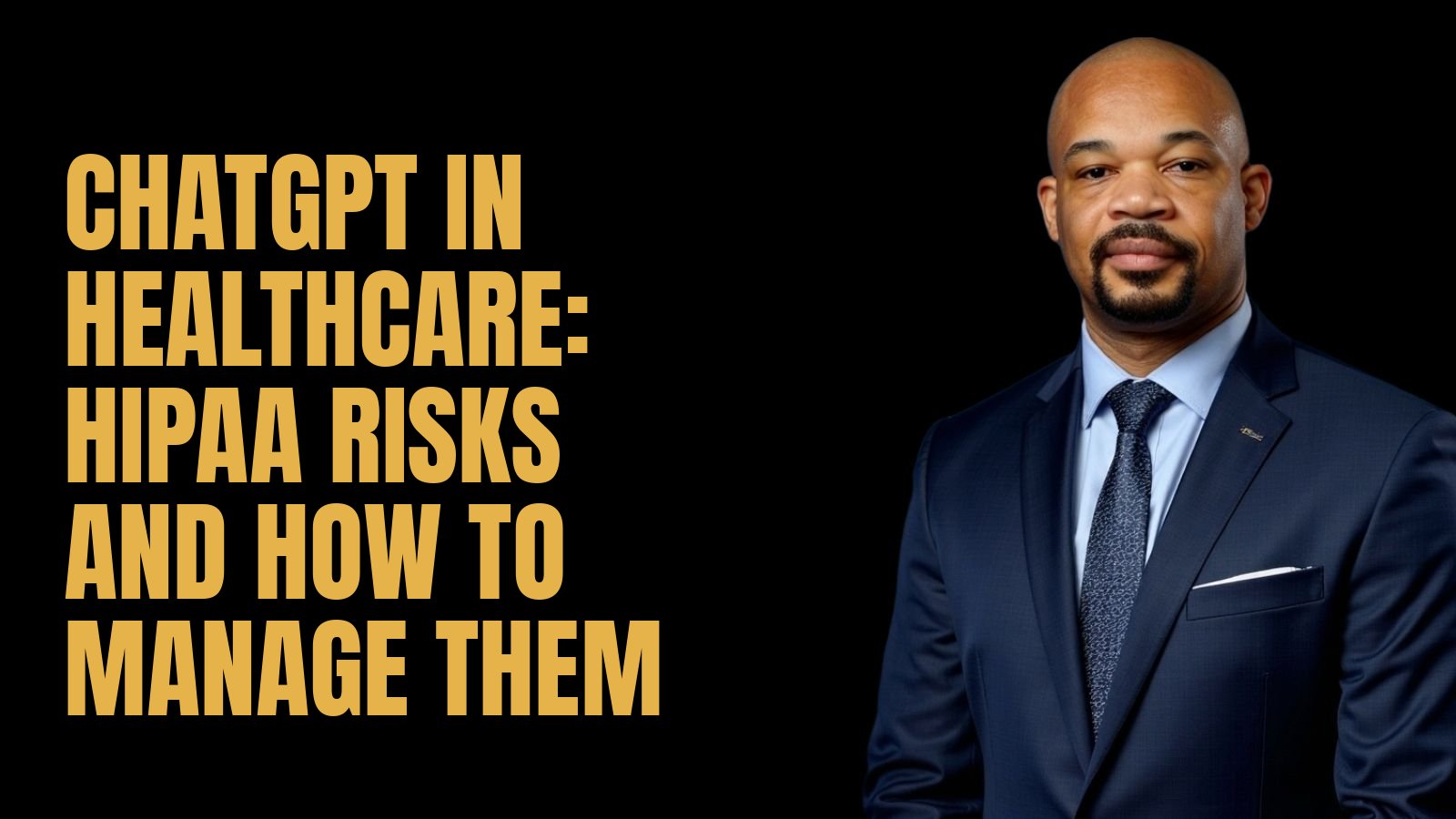
I've reviewed hundreds of HIPAA compliance programs across healthcare organizations, and one pattern has emerged clearly over the past eighteen months: clinical staff are pasting patient data into ChatGPT with alarming frequency. They're doing it to summarize chart notes, draft patient education materials, and translate medical terminology. They're doing it because it works, it's fast, and nobody told them it was a problem until after the fact.
This isn't hypothetical. In the organizations I work with, we've found evidence of protected health information (PHI) in ChatGPT prompts during access log reviews, workforce interviews, and incident investigations. The staff members involved are often surprised to learn they've committed a HIPAA violation. After all, they reason, they're not sharing information with another person—just a tool.
That reasoning fails the moment you understand what happens to data entered into consumer AI tools like ChatGPT. It also ignores the fundamental question every HIPAA-covered entity must answer: Is this use or disclosure of PHI permitted under our policies, and do we have the appropriate agreements in place?
Why Pasting Patient Data into ChatGPT Violates HIPAA
The standard version of ChatGPT—the one at chat.openai.com that anyone can access—is not HIPAA-compliant. When you paste text into the prompt box, that data goes to OpenAI's servers. OpenAI's Terms of Service for the consumer product explicitly state that they may use your input data to train and improve their models. This creates several distinct HIPAA violations.
First, you've disclosed PHI to a third party (OpenAI) without patient authorization and without a valid exception under the Privacy Rule. The disclosure isn't for treatment, payment, or healthcare operations. It's not pursuant to an authorization. It's not required by law. It simply doesn't fit any permitted disclosure category.
Second, you've done so without a Business Associate Agreement (BAA) in place. Any entity that creates, receives, maintains, or transmits PHI on behalf of a covered entity must sign a BAA. OpenAI doesn't sign BAAs for the consumer ChatGPT service, and they've made clear that it's not designed for HIPAA-regulated data.
Third, depending on what data you paste, you may have violated the Minimum Necessary standard. If you're copying entire progress notes when only a summary is needed, you're disclosing more PHI than necessary to accomplish your purpose—even if the disclosure were otherwise permitted, which it's not.
I've heard the argument that de-identification solves this problem. Staff members tell me they remove names, dates, and medical record numbers before pasting the text. This rarely constitutes proper de-identification under HIPAA. The de-identification standard under 45 CFR § 164.514 requires removal of 18 specific identifier categories and either statistical verification that re-identification risk is very small, or expert determination. Simply removing the patient's name doesn't cut it, especially when the clinical details remain specific enough to identify someone through context.
What OpenAI Actually Offers for Healthcare
OpenAI does offer an enterprise product (ChatGPT Enterprise and their API services) that includes different terms. Under certain configurations, they will sign a BAA and commit not to use your data for model training. This distinction is critical but widely misunderstood. The enterprise offering with a signed BAA is a different product with different technical controls, different legal terms, and a different price point. Having a "ChatGPT Plus" subscription doesn't make consumer ChatGPT HIPAA-compliant.
The pattern I see repeatedly: organizations discover a HIPAA violation after the fact, then scramble to understand which version of ChatGPT was involved and whether they can retroactively establish compliance. You can't. If PHI went to the consumer service, the violation occurred. You can implement controls to prevent future violations, but you can't undo the disclosure.
The Appeal and the Danger
Clinical staff turn to ChatGPT because it solves real problems. A physician finishes a complex patient encounter and faces thirty minutes of documentation. ChatGPT can draft the note in ninety seconds. A nurse needs to explain a new medication regimen to a patient with limited English proficiency. ChatGPT can generate translated patient education materials instantly. A care coordinator needs to summarize months of medical history for a specialist referral. ChatGPT can synthesize the information in seconds.
These aren't lazy clinicians looking for shortcuts. They're professionals drowning in administrative burden, trying to spend more time with patients and less time on documentation. The productivity gains are real and substantial. This is precisely what makes the problem so challenging for CISO and compliance teams.
Telling staff "just don't use AI tools" won't work. The productivity differential is too large, the tools are too accessible, and the competitive pressure is too strong. I've watched organizations try blanket bans. They fail because staff find workarounds, use the tools on personal devices, or simply ignore the policy. The better approach is to acknowledge the legitimate use case and provide compliant alternatives.
The danger isn't merely regulatory. OCR can impose civil monetary penalties for HIPAA violations, and they've shown increasing interest in AI-related complaints. But the operational risk matters too. Once patient data enters an AI training dataset, you lose control of it. You can't predict how it might surface in future model outputs. You can't call it back. In an era where we're teaching our workforce about data loss prevention, allowing uncontrolled PHI disclosure to third-party AI services contradicts every principle of information governance.
Need to Train Your Leadership on AI and HIPAA Compliance?
Carl delivers practical, experience-based guidance on managing AI tools in regulated environments. His presentations cut through vendor marketing and focus on what actually works in healthcare compliance programs.
Book Carl to Speak
Enterprise AI Alternatives That Support HIPAA Compliance
Several vendors now offer AI tools specifically designed for healthcare use with proper HIPAA compliance frameworks. These aren't perfect solutions, but they're substantially better than consumer ChatGPT from a compliance perspective. The key distinguishing features: willingness to sign a BAA, commitments not to use your data for model training, and technical controls that support audit logging and access restrictions.
Microsoft's Azure OpenAI Service provides access to GPT models through a Microsoft infrastructure with BAA coverage under Microsoft's broader HIPAA offering. This works well for organizations already using Microsoft 365 or Azure in their healthcare environments. The integration can be relatively straightforward, and you inherit Microsoft's compliance certifications and control frameworks. The limitation is that you're building your own interface or integration—this isn't a ready-made clinical tool, it's a platform.
Amazon Web Services offers Bedrock, which provides access to various foundation models including Claude and others. AWS will sign a BAA and offers the service as a HIPAA-eligible service. Like Azure, this is infrastructure rather than a turnkey application. You still need to implement appropriate access controls, audit logging, and user interfaces suitable for clinical workflows.
Google Cloud's Vertex AI provides similar infrastructure-level access to AI models with BAA coverage. The pattern across all three major cloud providers is consistent: they'll give you HIPAA-compliant infrastructure to build AI capabilities, but you're responsible for implementing it correctly within your environment.
Purpose-Built Clinical AI Tools
Beyond infrastructure platforms, several vendors have built clinical-specific AI tools with HIPAA compliance built in. Nuance's DAX and similar ambient documentation tools use AI to convert clinical conversations into structured notes. These operate under signed BAAs with extensive healthcare implementation experience behind them. They're expensive compared to consumer ChatGPT, but they're designed for the actual clinical workflow rather than adapted from consumer tools.
Several electronic health record vendors are embedding AI capabilities directly into their platforms. Epic's integration with Microsoft's Azure OpenAI Service, Cerner's AI initiatives, and similar offerings from other EHR vendors have the advantage of living within your existing BAA relationships and security boundaries. The disadvantage is that you're dependent on your EHR vendor's development timeline and implementation choices.
In my experience working with defense industrial base contractors, many of whom also handle healthcare data, the organizations that succeed with AI adoption do two things well. First, they establish clear approved tools before demand forces improvisation. Second, they make those approved tools easy enough to use that staff don't bypass them for consumer alternatives. If your compliant AI solution requires a help desk ticket, three days of waiting, and a cumbersome interface, staff will use ChatGPT on their phones instead.
Writing an AI Use Policy That Clinical Staff Will Follow
Most AI use policies I review fail because they're written by IT departments without input from clinical operations. The result is a policy that's either too restrictive to be useful or too vague to be enforceable. An effective AI policy for healthcare organizations needs to address both the compliance requirements and the operational reality.
Start with a clear statement of what's prohibited. Don't bury it in paragraph seven. Put it in plain language at the top: "You may not paste, upload, or otherwise input patient data, protected health information, or any identifiable health information into consumer AI tools including but not limited to ChatGPT, Claude.ai, Gemini, or similar services accessed through public websites." Specify that this applies regardless of device ownership—using your personal phone doesn't exempt you from HIPAA obligations.
Then immediately tell staff what they can use. List the approved AI tools available in your environment, how to access them, and what they're appropriate for. If you're prohibiting something that saves people thirty minutes a day, you need to offer an alternative that saves them at least twenty minutes. Otherwise your policy becomes fiction.
Defining Acceptable Use Cases
Your policy should specify which use cases are permitted even with compliant tools. In my work with healthcare organizations, I've seen reasonable approaches to this categorization. Documentation assistance—summarizing clinical notes, structuring dictation into formatted notes, expanding shorthand into complete sentences—is often permitted with appropriate tools. Patient communication—drafting education materials, translating information, simplifying medical terminology—is permitted with careful review before distribution.
Clinical decision support is where most organizations draw a harder line. Using AI to suggest diagnoses, recommend treatments, or interpret clinical findings requires much more careful governance. Some organizations prohibit it entirely in current policies, acknowledging that future versions might allow it under specific protocols. Others permit it only as a supplement to clinical judgment with explicit documentation requirements.
The pattern that works: be specific about what's allowed, what requires additional approval, and what's prohibited. Vague language like "use AI responsibly" guarantees inconsistent interpretation and ineffective compliance.
Training and Acknowledgment Requirements
Your policy needs teeth. Require annual training on AI use and regulatory compliance as part of your general HIPAA training program. Include specific examples of violations—not to shame anyone, but to make clear what the prohibited behavior looks like in practice. "Don't use ChatGPT with patient data" is less effective than "A nurse pasted a discharge summary into ChatGPT to simplify the language for a patient. This was a HIPAA violation because..."
Require written acknowledgment that staff have read and understand the policy. Make it part of onboarding for new employees and part of your annual compliance process for existing staff. Document the training and acknowledgments. When OCR asks what you did to prevent AI-related violations—and they will ask—you need to demonstrate active training, not just a policy in a manual somewhere.
Developing AI Policies for Your Healthcare Organization?
Carl works with healthcare compliance teams to develop practical AI governance frameworks that balance innovation with regulatory requirements. See all keynote speaking topics or reach out about your event.
Book Carl for Your Event
Technical Controls to Enforce Your Policy
Policy without technical controls is wishful thinking. Staff who don't understand the risk will violate your AI policy accidentally. Staff who do understand but face productivity pressure will violate it intentionally. You need technical measures that make violations harder to commit.
Web filtering and firewall rules can block access to consumer AI services from organization-owned devices and networks. This isn't perfect—staff can use personal devices on cellular connections—but it eliminates casual violations and forces intentional bypassing. Configure your web filter to block known AI services: chat.openai.com, claude.ai, gemini.google.com, and others. Maintain this list actively as new services emerge.
Data loss prevention (DLP) tools can detect potential PHI in outbound traffic and block or alert on suspicious patterns. Modern DLP can recognize medical terminology, MRN formats, ICD codes, and other healthcare-specific identifiers. Configure DLP rules that trigger on common patterns of PHI leaving your network toward known AI service endpoints. Accept that this won't catch everything—determined staff can work around DLP—but it raises the barrier and creates audit evidence.
Endpoint detection and response (EDR) tools can monitor for application usage patterns consistent with AI service access. If someone's browser is repeatedly posting large text blocks to AI services, that creates a detectable pattern. Your EDR can alert your security team to investigate. This requires tuning to avoid false positives, but it's valuable for detecting systematic policy violations.
Monitoring and Auditing
Implement logging for approved AI tools. Every query should create an audit record showing who made the request, when, and ideally what type of query. You don't necessarily need to log the full content of each interaction—that can create its own security concerns—but you need to know who's using the tools and how frequently. This serves both compliance monitoring and incident investigation.
Conduct periodic audits of AI usage. Review your DLP alerts for patterns. Interview a sample of clinical staff about their documentation workflows and what tools they use. Check browser history on shared workstations during routine security assessments. The goal isn't to conduct a witch hunt, it's to verify that your controls are working and that staff understand the policy.
In federal contractor environments, we implement these controls because contract requirements demand them and audit teams will verify them. Healthcare organizations should adopt the same rigor. The regulatory exposure is comparable, and the sensitivity of the data demands it. Implementing controls for AI use isn't fundamentally different from implementing controls for email, USB drives, or any other potential data exfiltration vector. It's information governance applied to a new technology.
Incident Response When Violations Occur
You will discover violations of your AI policy. When you do, your response matters both for remediation and for demonstrating compliance to regulators. The first question is always: what data was disclosed, and can we determine the scope?
If a staff member admits to pasting patient information into consumer ChatGPT, you need to establish which patients were affected, what information was disclosed, and over what time period. Interview the staff member with clear documentation. Review their work patterns and patient assignments to assess potential scope. Check for similar behavior by others in the same role or department—violations cluster.
Determine whether the disclosure meets the threshold for breach notification under HIPAA. If the data included identifiable patient information and went to an unauthorized third party without a BAA, that's a breach unless you can demonstrate a low probability of compromise under the four-factor risk assessment. In most cases involving consumer AI services, you can't make that demonstration. The data was transmitted to OpenAI, they may have used it for training, and you have no mechanism to verify confidentiality.
Notification Decisions and OCR Reporting
If the breach affects fewer than 500 individuals, you're required to notify affected patients and report to OCR within 60 days of the end of the calendar year. If it affects 500 or more, notification must occur within 60 days of discovery, and OCR reporting is immediate. These thresholds matter because they drive your project timeline and resource requirements. A breach affecting 50 patients requires the same fundamental response as one affecting 500, but the timeline compression for larger breaches creates operational challenges.
Your notification to affected patients must be clear about what happened. I recommend straightforward language: "On [date], we discovered that a staff member entered your health information into an artificial intelligence tool called ChatGPT without proper authorization. This tool is operated by OpenAI, Inc., and is not covered by our security agreements. The information entered included [describe types of information]. We have no evidence that your information has been misused, but we cannot guarantee that OpenAI will not use or disclose it."
OCR reporting requires similar candor. Describe what happened, what information was involved, how you discovered it, what you've done in response, and what controls you've implemented to prevent recurrence. If you implemented staff training, updated your policies, deployed technical controls, and took appropriate corrective action with the involved employee, say so. OCR wants to see that you took the violation seriously and responded comprehensively.
The Broader Privacy Implications
ChatGPT HIPAA compliance is one dimension of a larger challenge: how do we use powerful AI tools while maintaining appropriate control over sensitive data? Healthcare faces this question acutely because HIPAA creates clear legal obligations, but every organization handling sensitive information confronts similar tensions.
The same issues that make consumer ChatGPT inappropriate for PHI apply to other data categories. Federal contractors can't paste CUI or ITAR-controlled information into consumer AI tools. Financial services firms can't input customer financial data. Legal firms can't input privileged client communications. The regulatory frameworks differ—HIPAA, CMMC, GLBA, professional responsibility rules—but the fundamental problem is identical.
Organizations that develop clear policies and practical controls for AI use with healthcare data can extend that framework to other sensitive data categories. The risk assessment process is similar: identify what data needs protection, determine where it might leak through AI use, evaluate compliant alternatives, implement technical controls, train staff, monitor compliance. Whether you're protecting PHI, CUI, or trade secrets, the methodology transfers.
Privacy advocates emphasize that individuals should understand how to protect their personal information online. The same principle applies organizationally. Healthcare organizations need to understand how AI tools handle their data, what privacy commitments vendors make, and how to verify compliance. Reading the terms of service isn't optional when you're considering tools that might touch patient data.
Strategic Implications for Healthcare Leadership
The organizations that will succeed with AI in healthcare are those that recognize this isn't primarily a technology problem. It's a governance problem that requires coordination across clinical operations, IT, legal, compliance, and executive leadership. Your CISO can't solve this alone. Your CMO can't solve it alone. It requires partnership.
Clinical leadership needs to articulate the legitimate use cases and productivity requirements. What documentation burdens can AI reasonably address? What communication tasks consume excessive clinician time? What administrative work prevents direct patient care? These questions inform which AI capabilities you need to provide through compliant channels. If you don't understand the pressure driving staff to use consumer AI tools, you can't offer effective alternatives.
IT and security leadership must translate those requirements into technical solutions within the compliance boundary. That might mean implementing Azure OpenAI Service with appropriate access controls. It might mean negotiating with your EHR vendor to accelerate their AI roadmap. It might mean building custom integrations using vendor APIs with signed BAAs. The technical solution depends on your environment, your resources, and your timeline.
Compliance and legal teams need to provide clear guidance on what's permissible and what creates unacceptable risk. That guidance should be specific enough to be actionable. "Use AI responsibly" isn't guidance. "You may use Azure OpenAI Service accessed through our approved portal for documentation assistance, but you may not use it for clinical decision support without additional review" is guidance.
Executive leadership must allocate resources for compliant AI implementation. Enterprise AI solutions with proper HIPAA controls cost more than free ChatGPT accounts. Building governance frameworks takes compliance and IT time. Training staff requires investment. These are costs of doing business in a regulated industry that wants to adopt new technology. Organizations that try to use AI without proper investment will either violate HIPAA or fail to capture AI's benefits. Neither outcome serves patients or organizational sustainability.
The pattern I've observed across healthcare organizations, federal contractors, and other regulated entities: those that treat AI governance as a strategic priority—with executive sponsorship, cross-functional coordination, and appropriate resources—successfully adopt AI capabilities while maintaining compliance. Those that treat it as an IT problem to be solved with technical controls alone struggle with both compliance failures and limited AI adoption. Your approach to ChatGPT and HIPAA compliance signals which path your organization is taking.