
I've watched teams work 80-hour weeks preparing for audits that should have taken one person three days. Documentation that should have been ready to pull became a company-wide archaeology project. Evidence that existed somewhere in someone's email became a scavenger hunt across fifteen different systems. The audit itself turned into a negotiation about what we could produce versus what we should have already had.
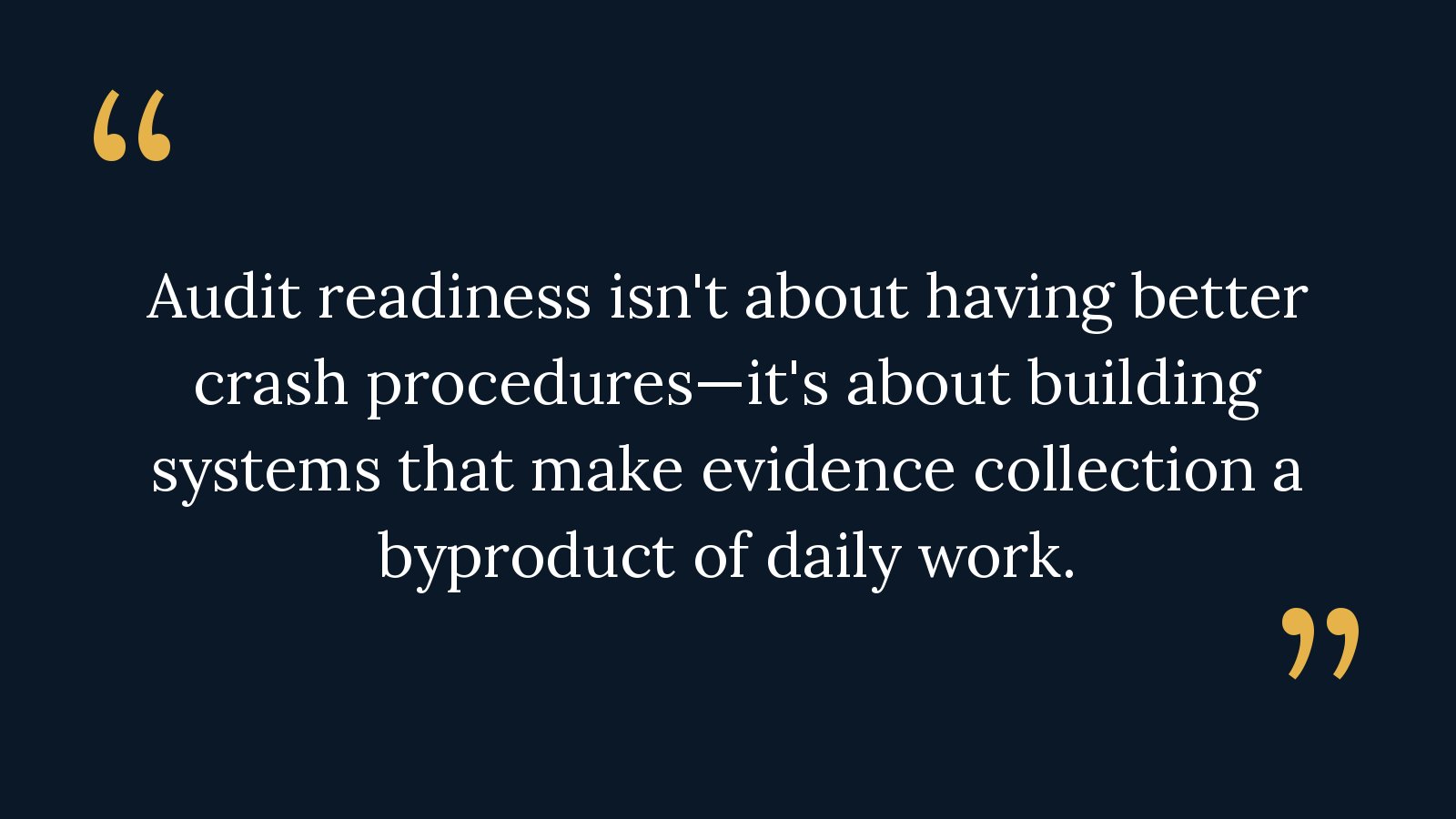
This happens because most organizations treat audits as events rather than as the natural output of how they operate. Audit readiness isn't about having better crash procedures—it's about building systems that make evidence collection a byproduct of daily work instead of a quarterly crisis.
The difference between these approaches is the difference between running a business and running a compliance theater company.
Why Scrambling Has Become Standard Practice
The pattern I see across industries is remarkably consistent. Organizations implement controls to pass an assessment, then let those controls drift until the next audit cycle approaches. Three months before the auditor arrives, someone gets tasked with "audit prep," which really means reconstructing evidence that may or may not prove the controls actually worked.
This happens for several structural reasons. First, the people who implement security controls rarely think about evidence collection as part of the control design. They focus on making the control work technically, then bolt on documentation as an afterthought. Second, the systems that generate evidence—ticketing platforms, configuration management tools, training systems—don't talk to each other. Evidence exists, but assembling it requires manual export-and-compile work. Third, and most damaging, leadership treats compliance as a separate function from operations rather than as a lens on how operations should already work.
I worked with a defense contractor that had genuinely strong security practices. Patch management happened on schedule. Access reviews occurred quarterly. Incident response procedures worked. But when their CMMC assessment approached, they spent six weeks reconstructing evidence because none of those activities had been performed with evidence capture in mind. The security was real; the audit readiness was nonexistent.
The cost of this approach compounds. Direct costs include the labor hours spent scrambling, the consultant fees paid to people who specialize in emergency evidence assembly, and the productivity loss across teams pulled into the effort. Indirect costs include the decisions delayed because leadership is focused on audit prep, the security improvements postponed because resources are consumed by documentation projects, and the institutional cynicism that grows when people recognize they're doing work twice.
What Continuous Evidence Collection Actually Means
Continuous evidence collection means designing your security and compliance activities so they automatically generate auditable records in a centralized, searchable, time-stamped format. When an auditor asks for evidence of quarterly access reviews, you run a report. When they want proof of security awareness training, you export the data. When they need documentation of incident response, you pull the tickets.
This isn't about creating more documentation. It's about capturing the evidence of work you're already doing in a format that serves both operational and compliance needs.
The practical components include:
- Centralized logging and monitoring that captures security-relevant events with tamper-evident storage and retention periods that match your compliance requirements
- Configuration management databases that maintain authoritative records of your asset inventory, system configurations, and change history
- Workflow automation that enforces documented procedures and captures evidence that those procedures were followed
- Integrated GRC platforms that map controls to evidence sources and maintain a continuous view of compliance posture
The key insight is that these aren't compliance-specific systems. They're operational systems that make your security program more effective while simultaneously generating compliance evidence. A well-designed ticketing workflow makes incident response more consistent. The compliance evidence is a byproduct.
The Evidence Mapping Exercise
Before you buy tools or redesign processes, map your current evidence landscape. Take your compliance framework—HIPAA, CMMC, SOC 2, whatever applies—and for each control requirement, document where the evidence currently lives, how it's generated, and how much manual effort is required to produce it for an auditor.
This exercise reveals patterns. You'll find controls where evidence generation is already automated and controls where evidence doesn't exist at all. You'll identify systems that generate useful logs nobody's preserving and manual processes that create paper trails nobody can find six months later. You'll see which gaps can be closed with process changes and which require tool investments.
I've never run this exercise with a client where leadership wasn't surprised by the results. The assumed state and the actual state of evidence collection rarely match.
Building the Technical Foundation
The technical architecture for audit readiness rests on three pillars: evidence generation, evidence preservation, and evidence retrieval. Each requires different capabilities.
Evidence generation happens at the control level. Access management systems need to log access grants, modifications, and revocations with details about who approved what and when. Training platforms need to record not just completion but also the content version delivered and the verification method used. Vulnerability scanners need to capture not just current state but also historical trends and remediation timelines.
The critical decision is whether to generate this evidence natively or through integration. Native evidence—built into the tool performing the control—is cleaner and more reliable. Integrated evidence—captured by connecting tools through APIs or log forwarding—offers more flexibility but introduces failure points. In my experience, native evidence wins for core security controls, while integration makes sense for business systems that support compliance objectives.
Evidence preservation requires storage systems designed for compliance use cases. These systems need immutability features that prevent tampering, retention policies that match regulatory requirements, and access controls that limit who can modify or delete records. Standard file shares and email archives don't meet these requirements.
Most organizations underestimate storage requirements. Logs are voluminous. Configuration histories grow. Training records accumulate. When a healthcare organization needs to retain HIPAA evidence for six years and a defense contractor needs three years of CMMC evidence, the storage math changes quickly. Cloud object storage with lifecycle policies usually provides the most cost-effective solution, but encryption and access control design matter more than the storage medium.
Evidence retrieval determines whether your audit readiness effort succeeds or becomes an expensive archive nobody can use. The test question is simple: Can a competent analyst who didn't build the system produce the evidence for any control in under an hour?
This requires indexing, tagging, and search capabilities that most compliance teams don't think about until audit season. Evidence needs consistent naming conventions. Storage locations need logical organization. Retrieval procedures need documentation that survives personnel changes.
The Tool Selection Reality
Vendors sell audit readiness as a product you can buy. GRC platforms promise unified evidence management. Security tools advertise compliance reporting. Integration platforms claim to connect everything seamlessly.
Some of these claims are legitimate. Many are oversimplified.
The organizations I've seen succeed with GRC platforms are those that already had mature processes and used the platform to centralize and systematize what they were doing manually. The organizations that struggled were those that bought the platform hoping it would tell them what to do. GRC tools are workflows and databases. They automate processes you define, but they don't substitute for understanding your compliance requirements or designing controls that address them.
When evaluating tools, focus on integration capabilities and evidence quality over feature checklists. A platform that integrates cleanly with your existing security stack and preserves detailed evidence is more valuable than one with impressive dashboards that require manual data entry. Ask vendors for evidence exports, not screenshots. Look at the actual data structure, the timestamp precision, the audit trail completeness.
Also recognize that no single platform handles everything. You'll have a GRC tool for control mapping and assessment management, a SIEM for security event evidence, a configuration management system for asset and change evidence, and various point solutions for specific controls. The question isn't whether to consolidate—full consolidation is a fantasy—but rather how to make these systems interoperate efficiently.
Need Help Building Audit Readiness Into Your Program?
Carl speaks to leadership teams and boards about transforming compliance from a periodic crisis into a continuous operational capability. His sessions are built on real implementation experience, not vendor talking points.
Book Carl to SpeakProcess Design That Enables Continuous Compliance
Technology enables audit readiness, but process design determines whether you actually achieve it. The shift from event-based to continuous compliance requires rethinking how you document procedures, assign responsibilities, and verify control effectiveness.
Start with procedure documentation. Most organizations have compliance procedures written for auditors rather than for the people performing the work. These documents describe what should happen in formal language but don't integrate with how work actually flows. The person provisioning access follows the workflow in the identity management system; they don't open a procedure document.
Effective procedure documentation serves two audiences simultaneously. For practitioners, it's embedded in the tools they use—workflow steps, approval requirements, data validation rules built into the systems. For auditors, it's formal documentation that describes the design and operation of those controls with explicit references to where evidence is captured.
This dual-purpose approach eliminates the common problem where documented procedures and actual practices drift apart. When the procedure is the workflow, they can't diverge without someone actively bypassing the system.
Making Control Testing Continuous
Annual or quarterly control testing creates the scrambling cycle. You test controls, find issues, remediate before the audit, then let things drift until the next test cycle. Continuous control testing means automating evidence collection and building exception detection into your operational dashboards.
For technical controls, this is often straightforward. Your vulnerability management system already tracks patch compliance. Configure it to alert when systems fall outside policy thresholds. Your access management system already knows which accounts have which permissions. Configure it to flag access that violates policy or hasn't been reviewed within the required timeframe.
For administrative and physical controls, continuous testing requires more creativity. Training compliance can be monitored through learning management system dashboards. Policy acknowledgments can be tracked through workflow systems. Physical access logs can be reviewed programmatically for anomalies.
The goal isn't to eliminate human judgment from control testing. It's to shift that judgment from periodic bulk reviews to exception-based ongoing oversight. Instead of reviewing 100% of access permissions quarterly, you review exceptions daily and validate a sample of the automated review process quarterly. The coverage improves while the effort decreases.
Responsibility Assignment That Survives Change
Audit readiness fails when it depends on specific people rather than defined roles. The person who knows where all the evidence lives leaves the company. The team that handled audit prep gets reorganized. The institutional knowledge evaporates.
Building sustainable audit readiness requires documenting roles and responsibilities in a way that survives personnel changes. This means formal RACI matrices that identify who's responsible for evidence collection for each control family, documented procedures for evidence retrieval that assume the reader is encountering the system for the first time, and cross-training that ensures at least two people can locate and produce evidence for any control.
In my experience, organizations that treat audit readiness as one person's job—the compliance manager, the GRC analyst—are setting themselves up for failure. That person becomes a bottleneck and a single point of failure. Organizations that distribute evidence ownership across the teams actually performing the work build more resilient capabilities.
The Cultural Shift Leadership Must Drive
The technical and process changes required for audit readiness are manageable. The cultural change is harder and more important.
Most organizations have internalized a compliance culture where documentation is separate from real work. People do their jobs, then someone else documents what happened for compliance purposes. This creates friction, duplicates effort, and produces documentation that doesn't reflect reality.
Shifting to continuous audit readiness requires making compliance evidence a first-class output of operational work. When you design a new security control, evidence capture is part of the design. When you implement a new process, the audit trail is part of the implementation. When you evaluate tools, evidence quality is part of the evaluation criteria.
This shift only happens when leadership makes it a priority. Specifically, leadership must:
- Include evidence capture requirements in project planning and resource allocation rather than treating it as a post-implementation add-on
- Measure and reward teams based on continuous compliance posture rather than just audit pass/fail outcomes
- Invest in the tools and training required for evidence automation instead of relying on manual heroics
- Hold managers accountable for the evidence quality their teams generate, not just for their security outcomes
The hardest conversations I have with executives are about this cultural dimension. They understand the value proposition intellectually—less scrambling, lower costs, better security—but implementing it requires changing how they think about compliance and regulatory compliance more broadly. It requires treating compliance as an inherent attribute of how you operate rather than as an external assessment you prepare for.
When Audit Readiness Conflicts With Agility
A common objection to continuous compliance is that it slows down operational teams. Creating audit trails adds steps. Maintaining evidence adds overhead. Moving fast requires breaking things, not documenting everything.
This objection contains a grain of truth wrapped in a false dichotomy. Yes, evidence capture has a cost. No, it doesn't have to impede agility.
Well-designed audit readiness infrastructure captures evidence as a byproduct of work that needs to happen anyway. Change management improves system stability; the documentation is a byproduct. Access reviews reduce security risk; the audit trail is a byproduct. Security testing finds vulnerabilities; the evidence is a byproduct.
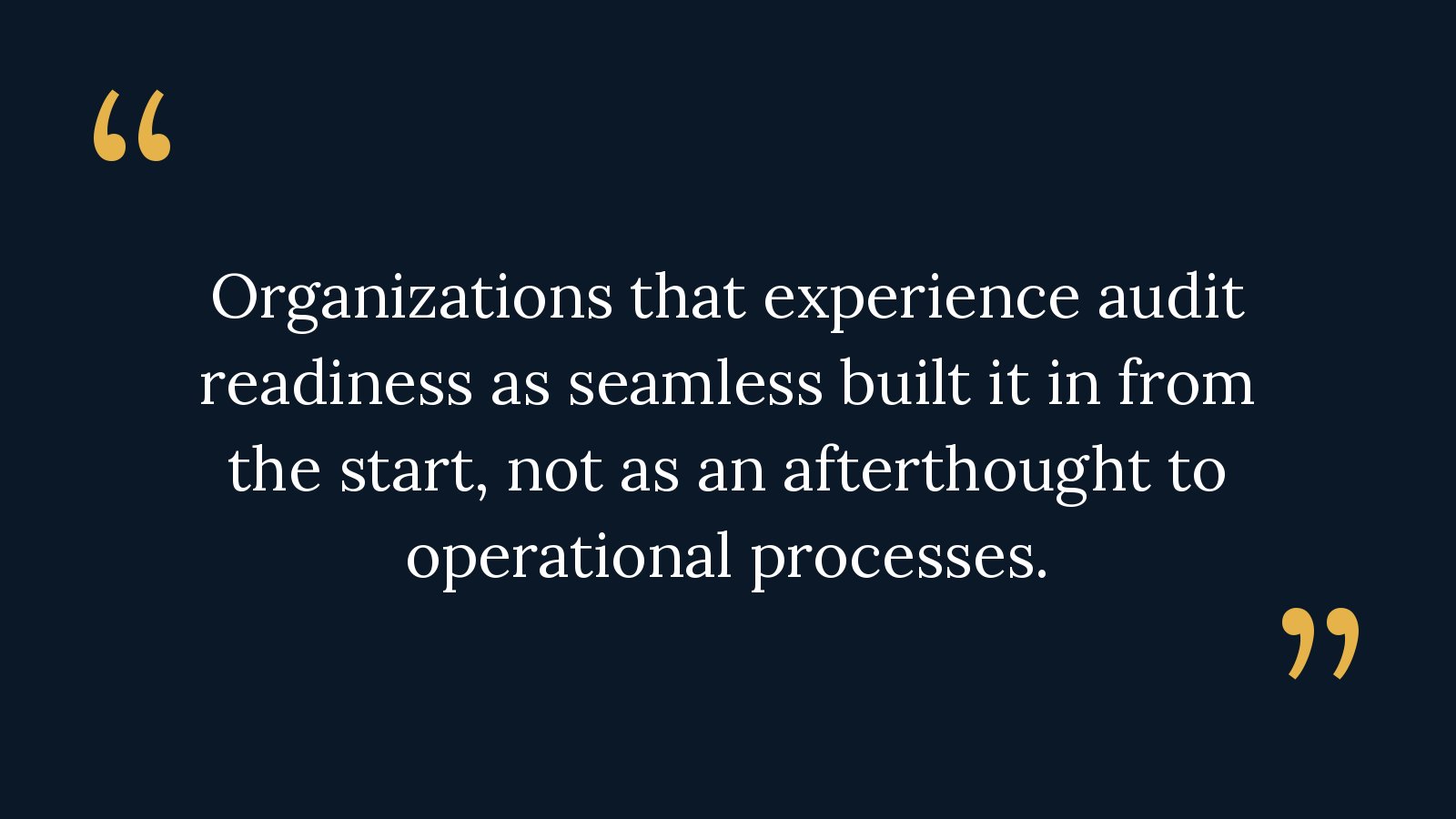
The organizations that experience audit readiness as friction are usually those trying to retrofit compliance onto operational processes that were designed without it. The organizations that experience it as seamless built it in from the start.
This is why leadership timing matters. Building audit readiness during a period of operational stability is easier than during rapid growth or major transformation. But waiting for the perfect moment means never starting. The practical approach is to implement evidence automation in stages, starting with the highest-volume or highest-risk controls and expanding over time.
Transform How Your Organization Thinks About Compliance
Carl delivers keynotes and workshops on building sustainable compliance programs that support business objectives instead of impeding them. See all keynote speaking topics or reach out about your event.
Book Carl for Your EventImplementation Roadmap: From Scrambling to Systematic
Moving from reactive to continuous audit readiness isn't a single project. It's a multi-stage transformation that typically spans 12-18 months for mid-sized organizations and longer for complex enterprises.
The first phase is assessment and prioritization. Conduct the evidence mapping exercise described earlier. Identify your highest-pain controls—the ones that consume the most effort during audit prep or carry the highest risk if evidence is missing. These become your initial targets.
For most organizations, access management evidence ranks high on this list. Access provisioning and deprovisioning happen constantly. Access reviews occur quarterly or annually. The volume of evidence is substantial, and gaps create serious audit findings. Starting here delivers visible value quickly.
The second phase is foundational infrastructure. Implement the core systems required for evidence preservation and retrieval: centralized logging with appropriate retention, a configuration management database, and basic GRC tooling if you don't already have it. This phase is primarily a technical effort requiring coordination between IT, security, and compliance teams.
Phase three is control automation and integration. This is where you redesign high-priority controls to generate evidence natively, integrate systems to centralize evidence collection, and build the dashboards and reports that make evidence retrieval straightforward. This phase requires cross-functional work and process redesign, not just technical implementation.
Phase four is operationalization and cultural embedding. Training teams on new procedures, shifting from periodic to continuous control testing, establishing ownership and accountability for evidence quality, and demonstrating the value through reduced audit preparation time. This phase determines whether your technical investments actually change how the organization operates.
Throughout these phases, communication matters more than most technical teams appreciate. People need to understand why evidence capture matters, how it makes their work easier rather than harder, and what success looks like. Without this context, automation efforts get perceived as surveillance or makework.
Measuring Progress and Demonstrating Value
Leadership needs metrics to justify the investment in audit readiness and track progress. The right metrics focus on efficiency and risk reduction rather than compliance theater.
Track labor hours spent on audit preparation over time. As your audit readiness improves, this number should decrease substantially. A meaningful implementation should reduce audit prep time by 60-80% within 18 months.
Measure time-to-evidence for key controls. How long does it take to produce evidence when an auditor requests it? Mature audit readiness programs can produce evidence for most controls within hours, not days or weeks.
Monitor control exception rates and remediation times. Continuous compliance makes exceptions visible immediately rather than during periodic testing. The initial visibility often reveals more exceptions, which can look like regression but actually represents improved detection. What matters is whether exceptions get remediated faster once detected.
Track audit findings and corrective action times. Organizations with strong audit readiness typically see fewer findings related to missing or inadequate evidence and faster closure of findings that do occur.
These metrics tell a story about operational maturity, not just compliance checkbox-completion. That story resonates with boards and executives in ways that compliance-specific metrics often don't.
Common Failure Patterns and How to Avoid Them
I've seen audit readiness initiatives fail in predictable ways. Recognizing these patterns helps you avoid them.
The first failure pattern is tool-first thinking. Organizations buy a GRC platform expecting it to solve their audit readiness problems, then discover the platform requires extensive configuration, process definition, and data integration work they didn't anticipate. The tool becomes shelfware or a data entry burden that creates new problems instead of solving existing ones. The fix is process-first thinking—understand your evidence needs and design your workflows before selecting tools to support them.
The second pattern is compliance team ownership without operational buy-in. The compliance team builds beautiful evidence repositories that operational teams ignore because the evidence capture interferes with how they actually work. Evidence quality suffers, and the organization reverts to scrambling mode when audits approach. The fix is distributed ownership where the teams performing controls own the evidence quality, with the compliance team providing coordination and oversight rather than doing the work.
The third pattern is perfection paralysis. Teams try to automate everything at once, get overwhelmed by the scope, and never achieve meaningful progress. The fix is incremental implementation focused on high-value controls with visible pain points.
The fourth pattern is brittle automation that breaks when systems change. Evidence collection gets tightly coupled to specific tool configurations, and when those tools get upgraded or replaced, the evidence pipeline breaks. The fix is designing evidence collection with abstraction layers—standardized data formats, API-based integration, and documentation that makes dependencies explicit.
The fifth pattern is evidence collection without evidence validation. Teams automate evidence capture but don't verify that the evidence is actually complete, accurate, and useful for audit purposes. They discover during the audit that their automated evidence doesn't meet auditor requirements. The fix is involving your auditor or a qualified third party in evidence design, not just evidence review.
Strategic Implications for Security Leadership
Audit readiness has implications beyond reducing the pain of compliance assessments. It fundamentally changes what a security program can accomplish and how it's perceived within the organization.
First, continuous evidence collection dramatically improves security visibility. When you have detailed, searchable logs of security-relevant events, you can answer questions that would otherwise require investigation projects. How many high-risk vulnerabilities were remediated within SLA last quarter? Which applications have privileged access that hasn't been reviewed in 90 days? What percentage of employees completed security awareness training within 30 days of hire? These aren't compliance questions—they're operational questions that drive security improvements. Audit readiness infrastructure makes them answerable.
Second, strong audit readiness reduces the business disruption of assessments. When audits become data extraction exercises rather than company-wide mobilizations, they don't derail project timelines or consume leadership bandwidth. This makes compliance more sustainable and reduces the organizational fatigue that comes from treating every assessment as a crisis.
Third, audit readiness enables faster response to new compliance requirements. When a new regulation applies or a customer requires a new certification, organizations with mature evidence collection can assess their current posture and identify gaps quickly. Those without it spend months just understanding their current state before they can begin remediation.
Fourth, and perhaps most strategically, audit readiness shifts security's relationship with the business from cost center to enabler. When your organization can demonstrate compliance posture continuously rather than periodically, it can pursue opportunities that require rapid compliance validation. When evidence collection is automated rather than manual, security teams can focus on risk reduction rather than documentation assembly. When audit preparation doesn't require cross-functional heroics, security is perceived as organized and professional rather than as a source of periodic chaos.
These benefits compound over time. The first audit cycle after implementing continuous compliance still requires significant effort because you're validating that your new systems work. The second cycle requires much less. By the third cycle, audit preparation is a routine operational activity that doesn't dominate the quarter.
For CISOs and security leaders, this transformation changes the conversation with executive leadership. Instead of defending budget for audit preparation or explaining why the security team needs help from across the organization every time an assessment approaches, you can focus on actual security improvements and risk reduction. Instead of being the person who brings bad news about audit findings, you can bring data about control effectiveness and security posture trends.
The cultural impact extends beyond the security team. When other parts of the organization see that security controls generate useful operational data in addition to compliance evidence, they become more willing to adopt those controls. When audit preparation stops being a company-wide fire drill, compliance stops being something people dread and starts being something that's simply part of how you work.
This is the real value of audit readiness: not just reducing scrambling, but building a security and compliance program that's sustainable, data-driven, and integrated with how your organization actually operates. That foundation enables you to take on more ambitious security initiatives because you're not constantly underwater handling compliance crises.
The organizations that excel in their industry—whether healthcare, defense contracting, or any other regulated sector—aren't those that treat compliance as a separate function. They're the ones that build compliance into their operational DNA and make evidence generation an automatic byproduct of secure, well-managed operations. Building that capability requires investment, patience, and leadership commitment. But the alternative is scrambling forever, and that's not a sustainable strategy for any organization that wants to grow.